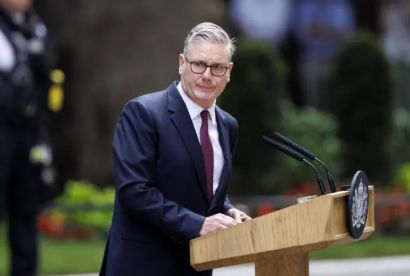
The resignation of Keir Starmer marks the end of an era in British politics. His departure inevitably prompts reflection not only on his leadership, but also on the democratic processes now unfolding around his successor.
Perhaps the most striking aspect of Starmer's resignation was the tone of his farewell speech. For a politician frequently criticised for appearing distant, managerial or overly cautious, his final address revealed a more personal side. He showed genuine emotion, and it was a reminder that behind every political leader is a human being carrying the weight of difficult decisions, relentless scrutiny and enormous responsibility.
One of the most common criticisms of Starmer throughout his leadership was his perceived inability to connect emotionally with the public. Yet, for many observers, it was only at the moment of his departure that they felt they saw the authentic individual behind the office. By then, of course, it was too late.
And in a moment of reflection for us as a country, as we look forward to the seventh Prime Minister in just over ten years, is the job simply becoming impossible? Andy Burnham will hope not.
When all is said and done, I think history will look upon Starmer as a fundamentally decent man attempting to serve his country to the best of his ability. That does not mean every decision was correct, nor that every criticism was unfair. But democracy benefits when political disagreement remains grounded in the recognition that opponents are not necessarily acting in bad faith.
Attention now turns to Labour's leadership contest. With Health Secretary Wes Streeting publicly backing Andy Burnham, momentum appears to be building rapidly behind the now-former Greater Manchester Mayor. Indeed, it is now possible that there is no leadership contest at all, simply a Burnham coronation.
This is where questions about democratic legitimacy and democratic engagement become particularly interesting.
From Labour's perspective, avoiding a prolonged and divisive leadership battle is entirely rational. Political parties naturally seek unity, especially when governing. Internal contests can expose ideological divisions and heighten interpersonal conflict and division. There are clear political advantages in rallying around a single candidate.
However, democracy is not solely about efficiency. Competition, debate and the testing of ideas are also important democratic values. Leadership contests provide opportunities for alternative visions to be heard and for party members to shape future direction. When succession appears predetermined, there is a risk the public, or party members, feel excluded.
This tension is not unique to Labour. Political parties must balance the need for unity and stability against the benefits of open competition and internal debate.
As the transition unfolds, the focus should not simply be on who succeeds Keir Starmer. The broader question is what the process tells us about the health of our democratic culture. Democracy is not merely about elections. It is about legitimacy, participation, accountability and public trust.
My overriding feeling is: how long before people start calling for the next Prime Minister to resign? In the current political climate, it probably won't be long.
Member discussion
Comments
No comments yet.
Log in or register to comment on this article.